

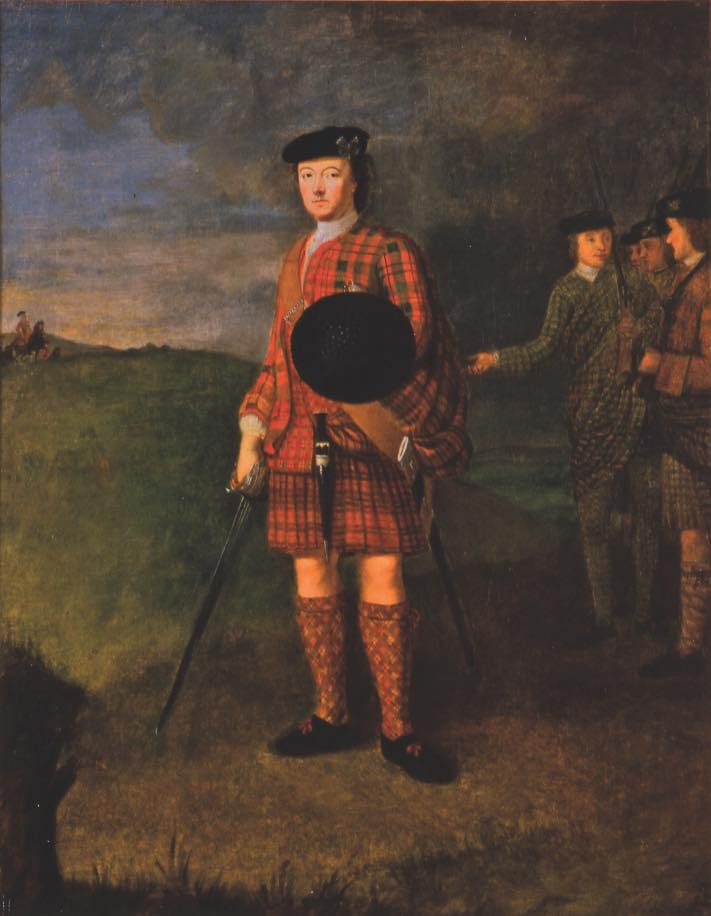
On 12 April 1746, four days before the Battle of Culloden, an unsigned paper was written that proposed that the Jacobite army should march out from Inverness and head south into Badenoch and Atholl, bypassing the Duke of Cumberland’s army in Aberdeenshire, and seize the town of Perth, cutting off Cumberland’s overland communications.1
The paper is believed to have been written by Lord George Murray, lieutenant-general in Charles Edward Stuart’s army, and was in response to Charles’s plan to march directly against Cumberland at Aberdeen. The same day, the Jacobites received confirmation that Cumberland had crossed the River Spey and was now advancing on Inverness, rendering both plans redundant.
Lord George and a detachment of the Jacobite army had launched the Atholl Raid on 14 March, capturing government outposts before laying siege to his brother’s seat of Blair Castle on the 17th. The siege was lifted on 2 April after Lord George was ordered to return to Inverness by Charles. A force of Hessians was also on the way to relieve the siege. It was likely that the move into Atholl served to prepare the ground for a larger move south to bypass Cumberland.
The proposal to outflank the Duke of Cumberland
I am not curious to dive into councils, yet, as I find it the general notion that our Army is preparing to attack the enemy in Aberdeenshire, and that I am as deeply concerned in the event as any other Gentleman, I cannot help presenting, at such a critical Juncture, a few hints that occurr to me with regard to that measure.
I believe in the first place it will not be deny’d that it wou’d be wrong in us to form a despicable notion of our Enemy’s councils, and risk a great deal upon the supposition of their blundering; on the contrary, I take it to be a maxim in war that we are to suppose the Enemy is to act the most prudent part, and take our measures accordingly, when we are under no necessity of doing desperate things; and should our affairs be ruined by failing in an enterprise attempted contrary to this maxim, our Leaders wou’d be justly blam’d by latest Posterity.
I pretend not to be so much skilled in matters of war as to determine absolutely what is best for the Enemy to do in pursuance of his real Interest; But let it only be supposed that his plan is to reduce us by famine, (and I think his conduct since he came to Aberdeen does not contradict this supposition). In consequence of this plan, as he knows that when the Provisions in these northern parts are consum’d we must either disband or march south at all hazards, he will endeavour to make the last as difficult and desperate for us as possible.
If this is the plan, it is the Enemy’s bussiness to shun a general engagement. Battles are never to be ventured without necessity, or an evident superiority in numbers or other circumstances; our Enemy is at present far from being reduced to the necessity of fighting, nor is it to be imagined he will humour us in that point which we have reason to desire most; how firey so ever the General of the Enemy may be represented, that fire will be bridled by a council, now that all is at stake, and that they have ceased from despising our Troops.
Let it be suppos’d next that our whole Army is assembl’d and in their march towards Aberdeen. Let it be suppos’d that the Prince of Hanover, having shiped off all his sick and heavy baggage, takes the start of us by two days’ march, passes Tay, and makes a stand; strongly guarding all the Fords upon that River and the defiles on the high Road towards Atholl: what are we to do next? To force a passage below Dunkeld will be impracticable;
To march up the high way to the head of the country will be equally impossible;
But something must be done; The Enemy will be in no hurry any more than they are at present; they’ll allow us as much time as we please to consume what they shall think fit
to leave behind, which, to be sure, will be as little as they can; So that the best thing we can do in that case will be to march thro’ the Hills to the head of Atholl, and there endeavour to force a passage, but how difficult this passage may be render’d if it is at all disputed, and what hardships we must suffer before we can form on the other side, and be in a condition to fight, may easily be imagin’d. As to the article of subsistance for our Horses in this expedition, and how we are to carry our ammunition, and provision for our men sufficient to serve them till we are masters of some plentiful countrey, Let our Commissaries consider.
But were it possible for us to surmount this last difficulty, and to suppose that our private men will be as much upon honour to stand by their colours in times of scarcity as our Gentlemen; that we pass Tay at or above the Bridge, with a little provision to carry us to the lower parts of Perthshire; The Enemy still intent upon his first plan of reducing us
by scarcity, and shunning a general engagement without necessity, will begin to send off or destroy every thing that can be of use to us, betwixt Tay and Forth, as soon as we begin our march towards the Highlands; their whole army will march off in due time for Stirling; and the Banks of the Forth must be the first place we can hope to come to a general
engagement, even supposing it to be possible under such circumstances to march our Army so far; and whether that is possible or not, or if the Army shall be in a condition to fight at a disadvantage after so much distress and fatigue, I leave to the consideration of our Generals and heads of Clans. It is scarce worth while to suppose that the P:of H: is
entrenching himself in good earnest at Aberdeen, with a view of commanding that coast and intercepting our succours from abroad, but if it should be the case, it would not be prudent to attack him in his Trenches, as he has but one side of the Town to guard with all his Artillery and Forces, having a River on each flank, and the Sea in his rear, and should
we march on and leave him there (by the by, it is not an easy matter to march deliberately having an enemy in flank), the passage of Tay anywhere but in the highlands would be still found impracticable, whilst the Hessians remain undisturbed in Perthshire, I imagine it is for this very purpose of disputing the passage of Tay they are left in that country; for were the P:of H: resolved to give battle, wou’d he not immediately, knowing the quickness of our motions, call the Hessians to make his army as strong as possible? and if they are making no movements to join him now, it is to me as clear as Demonstration that he is resolved not to give Battle in the north, but that his plan actually is to prevent our marching south as long as he can, and distress us by want of provisions.
For these reasons I think our marching towards Aberdeen at present would be risking all upon the bare possibility of the enemy’s overlooking his own Interest; whilst, on the contrary, if he does his Duty we are reduced to ineviteable Distress; and, to be sure, discovering his Interest in this particular requires no deep penetration; it must be obvious to every officer of the smallest experience.
This scheme being lyable to objections, in my opinion, great and essential, it must immediately occurr that marching the Highland Road is the only Resource left us, and no doubt many difficulties may be started here likewise, all which will centre in the article of provisions, and the necessity and difficulty of concealing our design ; nor is it possible I can enter into these particulars at present for want of the necessary Information, but I hope what I am about to suggest will be found not impracticable. Let it be supposed then that H: R: H: should order 5000 of his best troops (to make the work speedy and sure) to march into Atholl with expedition and secrecy, sending an advanced party, the strength of which to be regulate according to the Intelligence to be procur’d from that country. The passes upon Tumble and Tay will be easily seiz’d in the first place, and before the Prince of Hesse can receive any certain Intelligence of our numbers, the want of which will keep him for some time in suspens, our main Body may be so disposed as to prevent his retreat.
The natural consequence of this expedition well concerted and conducted wou’d be of infinite advantage; The Enemy must be deprived of these foreign auxiliaries, and we in possession of Tay and all the country to the south of it, besides all the Magazines of the Hessians. The rest of our Infantry might be order’d to follow by Drumuachter with the heavy baggage, and just provision enough to serve themselves till they arrive at Perth; and our Horse may, with proper Guides, march by different Routes thro’ Marr and Strathardle, where they will find forrage in plenty. H:R:H: and his Generals will easily concert and provide for this expedition by feign’d marches and feign’d pretences in such a manner that the P:of H: shall never be able to penetrate his real Design till it is too late to succour his ally.
By this means we get into the heart of the Kingdom where the provisions are not yet consum’d, and baffle the project the enemy has more than probably form’d of reducing us by want, and H:R:H: will have time to consider at his leisure what is to be done next. This wou’d be playing a game morally sure, whereas marching by Aberdeen wou’d put it
in the enemy’s power to reduce us to infinite distress without stricking a blow, and force us to attempt at last with infinite difficulty and distress, in his view and to his knowledge (besides the immediate prospect of more Difficulties and Distresses) what I humbly propose to be done by way of stratagem. The particular manner of providing for such an Expedition is a Detaille apart, and I scruple not to say that Major Fraser is a proper person to be concern’d in providing for this or any other project of the kind that is attempted.
Notes:
- Chronicles of the Atholl and Tullibardine families, volume 3, p 273. ↩︎
