

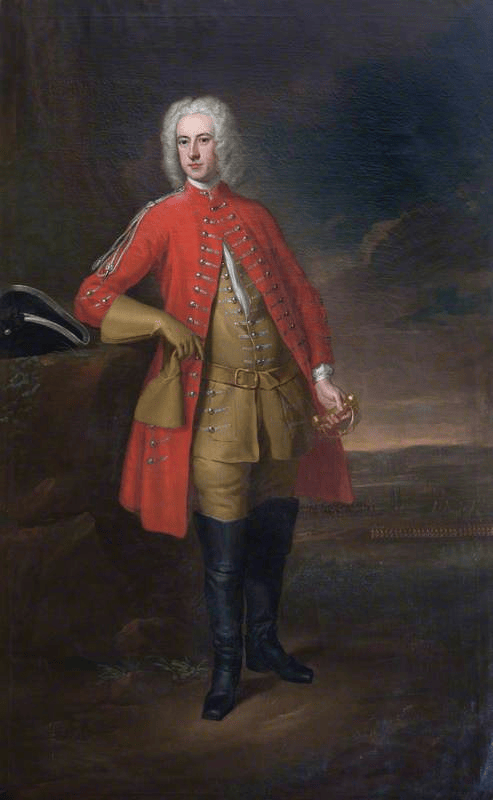
18 September 1715: The Duke of Argyll, commander-in-chief in Scotland, sent orders for the Greenock militia to be raised. The following day “the Greenick Companies were assembled in Arms, and after the Lady Greenock had told them, that the Protestant Religion, with their Laws, Liberties, Lives, and all that was dear to them, as Men and Christians, as well as his Majesty King George and
the Protestant Succession, were all in Hazard by that unnatural Rebellion”.1
18 September 1745: Lieutenant-General Sir John Cope’s army finished disembarking at Dunbar. Cope was reinforced with Gardiner’s and Hamilton’s dragoon regiments under Brigadier Thomas Fowke. Cope reported to the Marquis of Tweeddale that the dragoons were “extremely fatigued with the forced Marches they made to arrive here.” The following morning the army would march from Dunbar to Haddington.2
18 September 1745: Following the capture of Edinburgh the previous day, Charles Edward Stuart remained at the Palace of Holyroodhouse while the Jacobite army made preparations to decamp from Kings Park and move the short distance to the parks at Duddingston ready to meet Lieutenant-General Sir John Cope’s army on the outskirts of the city.3
Notes:
- Peter Rae, The History of the Late Rebellion: Rais’d Against His Majesty King George, (1718), p 227. ↩︎
- Report of the proceedings and opinion of the Board of General Officers, on their examination into the conduct, behaviour, and proceedings of Lieutenant-General Sir John Cope (1749), p 74. ↩︎
- “Journal & Memoires of Prince Charles’s Expedition into Scotland 1745-6, by a Highland Officer in his Army”, published in: The Lockhart Papers, (London 1817), vol 2, p 489. ↩︎
Article first published on 18 September 2025
