

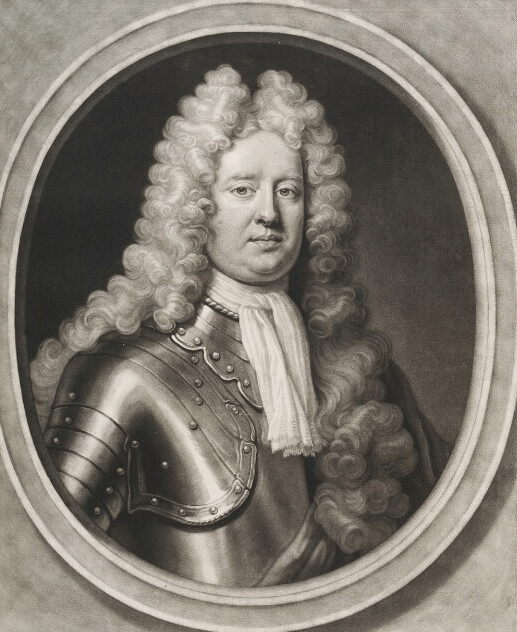
15 July 1715: Amid the growing Jacobite threat, David Boyle, 1st Earl of Glasgow, sent a summons from his seat at Kelburn Castle to raise the local fencible men and volunteers. Lord Glasgow had received “certain Intelligence, that the Clans and the other Jacobite Lords and Gentlemen there, were uppish, and big with the Hopes and Expectations of a sudden Invasion, and Appearance in Arms for the Pretender’s Interest; and understanding that there were but very few regular Troops in Scotland”.1 Lord Glasgow’s fencibles would form part of the 6,000 Cunninghame fencibles, which would assemble on Irvine Moor on 22 August for review.
15 July 1717: The Indemnity Act 1717, also known as the Act of Grace and Free Pardon, was given royal assent after being passed in both Houses of Parliament. The Act, which came over a year after the end of the Jacobite Rising of 1715-16, would lead to the freeing of hundreds of Jacobite prisoners. There were exceptions to the general pardon provided by the Act: Matthew Prior and Robert Harley, 1st Earl of Oxford, had been detained in the Tower of London prior to the Rising of 1715, along with Oxford’s associate Lord Harcourt and his relative Thomas Harley. Clan MacGregor was also barred from the pardon.2
15 July 1746: Andrew Fletcher, the Lord Justice-Clerk, wrote to the Duke of Newcastle to inform him that a ship which had carried some prominent Jacobites, including David, Lord Ogilvy, over to Bergen in Norway had returned to Scotland and was seized in Stonehaven. The ship’s captain, James Wymess, and his crew were arrested, and thirteen letters were seized. He also reported that he had received news from Luss that the Macgregors had agreed to surrender at the King’s mercy and that Brigadier John Mordaunt, based at Perth, would take the surrender and disarm the clan.3
15 July 1746: 15 July 1746: A party of Jacobites were taken by surprise while hiding in a hut in the Braes of Leny by the Perth volunteers, under the command of Captain James Campbell and Ensign Daniel Macqueen. The volunteers surrounded the hut and were then fired at from the door and windows before they returned fire. The firing continued for about fifteen minutes, after which the Jacobites, all wounded except one, surrendered and were carried as prisoners to Stirling. Among the prisoners were Major Stewart, brother to James Stewart of Ardvorlich, Captain Malcolm Macgregor, Captain Donald Maclaren, Sergeant King, a deserter of Lord John Murray’s Regiment, and three privates.4
Notes:
- Peter Rae, The History of the Late Rebellion: Rais’d Against His Majesty King George, (London 1745), p 186. ↩︎
- A faithful register of the late rebellion: or, An impartial account of the impeachments, trials &c., (London 1718), p 415. ↩︎
- Charles Sanford Terry (ed), The Albemarle Papers, vol 1, p 397. ↩︎
- The Scots Magazine, 1746, vol 8, p 247. ↩︎
Article first published on 15 July 2025
