

In May 1740, the 43rd Highland Regiment of Foot (Black Watch) mustered for the first time on the banks of the River Tay at Aberfeldy.
The regiment was formed under Royal Warrant on 25 October 1739, uniting six Independent Highland Companies to create a regular highland line regiment for service in the British Army. The colonelcy was assigned to Major-General John Lindsay, Earl of Crawford, while Sir Robert Munro of Foulis was appointed as Lieutenant-Colonel.1
By May 1740, when they assembled at General Wade’s Taybridge near Aberfeldy, four additional companies had been raised, boosting the regiment’s strength to 1,000 men.2 The Independent Highland Companies were re-established in 1725 by Major-General George Wade, who served as commander-in-chief in Scotland from 1724 to 1740. These companies were formed from loyal clans and were tasked with policing the highlands and enforcing disarming acts enacted after the Jacobite Rising of 1715. They also provided guidance and interpretation for regular troops and worked to suppress blackmail, the practice of paying protection money to deter cattle thieves, and was most likely the origin of their name, Am Freiceadan Dubh, or the Black Watch.3
While the name Black Watch is often linked to the dark tartan that the companies supposedly wore in the early days, there is evidence that some companies wore brighter tartan which might have been chosen in order to stand out from the majority of highland men who wore darker tartan which was “least likely to betray the wearer, among the woods and heaths, either to the game he was inquest of, or to his enemies.”4 The Clothing Book of 1742 and a contemporary image of the Black Watch on campaign in Germany in 1743 show soldiers of the regiment in brighter tartan than the later government-issued dark green and blue tartan.
Upon their establishment, General Wade instructed company commanders to ensure that all men wore plaids of the same or very similar colour for uniformity. This resulted in the companies being the first distinct Scottish subgroups recognized by their tartan, well over 50 years before lowland weavers invented clan tartans. The individual companies continued to wear tartan chosen by their commanders until around 1748, when the regiment was issued the dark government tartan.5
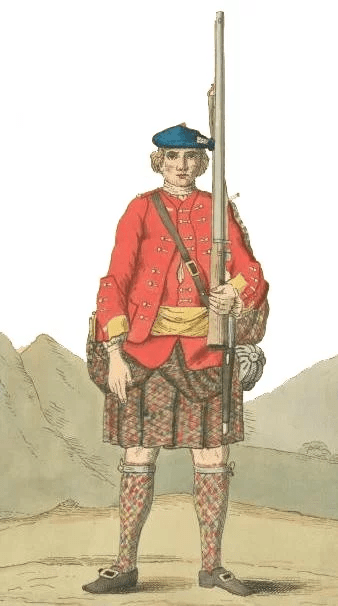
The rank and file were equipped with a Long Land Pattern musket, commonly referred to as the Brown Bess, along with a bayonet and a basket-hilted broadsword provided by the government. Additionally, they were allowed to carry a dirk, pistols, and a targe at their own expense, in accordance with highland tradition. Officers were armed with spontoons or fusils, while sergeants carried Lochaber axes. Upon being formed into a regiment, the companies received a scarlet jacket, blue bonnet, and buckled shoes.
After gathering at Aberfeldy, the regiment remained there for over a year, participating in regular drills and exercises under the command of Lieutenant-Colonel Munro. The following two years were spent in the highlands, where they occupied the forts and barracks, in addition to patrolling General Wade’s military roads.
In 1743, the regiment received orders to proceed to London for a review before being dispatched to the war in Europe. While in London, a rumour circulated that the regiment would be deployed to the West Indies, prompting over 100 men to mutiny and attempt to return home. They were swiftly apprehended, and three of the leaders were executed, while the remaining mutineers were assigned to garrison duty in the West Indies.
General Wade would not have been happy that the regiment had been taken out of Scotland as it undermined the purpose of his reestablishment of the Independent Highland Companies to police the Highlands.
On 30 April 1745, the regiment experienced its first combat at the Battle of Fontenoy in Belgium, where the British-Allied forces led by the Duke of Cumberland were defeated by the French army commanded by Marshal Saxe. They gained recognition for their assault on well-defended French positions before assisting in the retreat of Cumberland’s forces. Impressed by their performance, Cumberland suggested the formation of a second regular highland regiment, which was established as the Earl of Loudoun’s 64th Highland Regiment of Foot.
At the beginning of the Jacobite Rising of 1745, the regiment was campaigning in Flanders under Cumberland while three companies were stationed at Crieff. Following the Jacobite victory at the battle of Prestonpans the regiment was recalled to Britain and stationed on the south coast of England to guard against a French invasion. Of the three companies in Scotland, one was sent to garrison Inveraray and Fort William, one was taken prisoner following the battle of Prestonpans, and the third saw action at the battles of Falkirk and Culloden.
Notes:
- Royal Warrant addressed to John Lindsay, Earl of Crawford dated 25 October 1739; The London Gazette, 1 December 1739, no. 7862. ↩︎
- The muster site was in a field between Weem and Wade’s Bridge on what was part of the Aberfeldy Golf Club. The monument was sited on the opposite side of the river. ↩︎
- In a letter dated 20 December 1735, Major Lewis Grant writing to Robert Grant of Tammore, mentioned ‘Our Northern troops alias Blak Watch’, and in a letter dated 7 April 1739, Lord Lovat used the name Black Watch to refer to the Independent Highland Companies. ↩︎
- Edmund Burt, Letters from a Gentleman in the North of Scotland to his Friend in London, Volume 2, Fifth Edition, (London 1818), p 103. ↩︎
- The first depiction of the dark tartan issued to the Black Watch is from a painting of a Black Watch soldier by David Morier c.1750. ↩︎
Cite this article: Ritchie, N. S. (4 July 2025). The first muster of the Black Watch at Aberfeldy. Jacobite Wars. https://www.jacobitewars.com/articles/first-muster-black-watch-aberfeldy/
