

On 9 July 1745, over 100 miles west of Lizard Point, Cornwall, His Majesty’s Ship Lion encountered the French privateers Elisabeth and Du Teillay, which were carrying Charles Edward Stuart’s Jacobite expedition to the Western Highlands and engaged with them in a five-hour naval action.
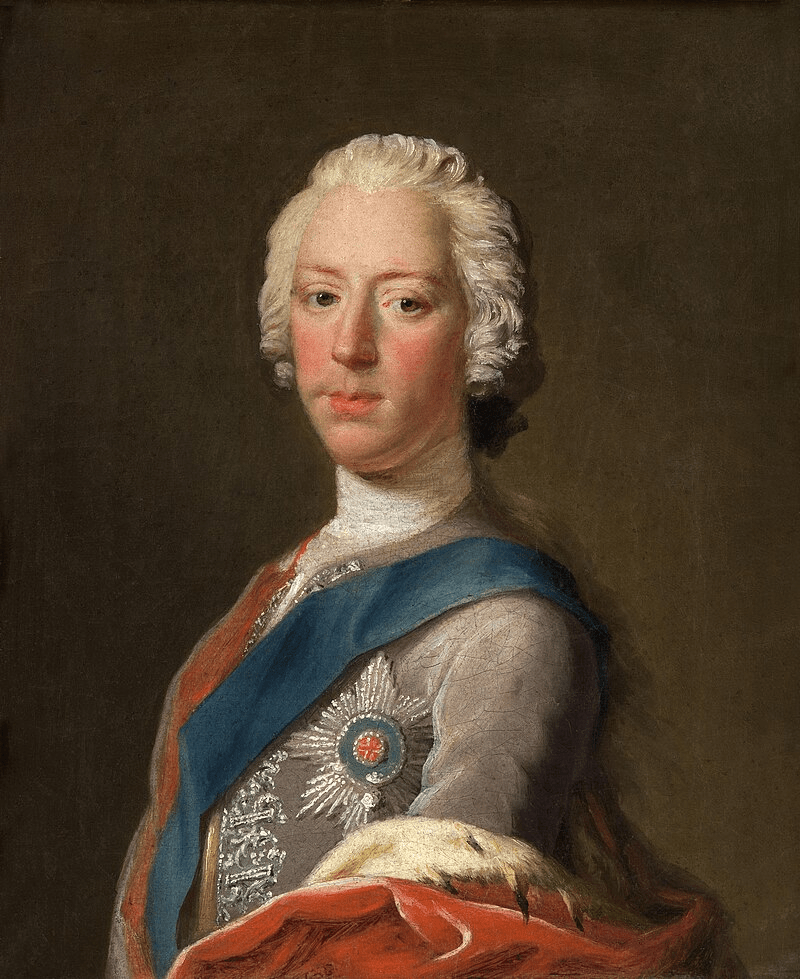
Charles Edward Stuart and his entourage of seven followers had departed from the port of Nantes on 17 June 1745, on board two small boats. Sailing down the Loire River, they arrived at St Nazaire that evening and the following morning, they boarded Du Teillay (16 guns), a privateer and slave ship which had been supplied by Franco-Irish slave trader and ship owner Antoine Walsh and was captained by Claude Durbé. On board was a cargo of muskets, broadswords and over 4,000 louis d’or.
Walsh accompanied Charles on his voyage to Scotland, and in addition to supplying his ship, had helped to fund the enterprise. The expedition had not been officially sanctioned by the French government and was in part financed by money from the Atlantic slave trade provided by the Irish community in France, as well as funds raised by pro-Jacobite bankers in Paris.
On the morning of 18 June, they made sail for Belle Isle, where later that day they dropped anchor and awaited the arrival of Elisabeth (64 guns), a former Royal Navy ship supplied by Irish merchant Walter Rutledge and commanded by Captain D’Eau. Elisabeth was carrying 1,500 muskets, 1,800 broadswords and 70 Irish volunteers from Lord Clare’s regiment in French service.1 After waiting off Belle Isle for over two weeks, Elisabeth finally arrived, and Captain D’Eau went aboard Du Teillay, where a council was held and everything was agreed upon for the voyage. On 5 July, with a favourable wind blowing, both ships set sail for Scotland.2
On 8 July, a squadron of eight Royal Navy warships was sighted on the horizon, and Elisabeth and Du Teillay changed course to avoid an encounter, hoping that they would slip past them that night. However, both ships had been spotted, and at daybreak the following morning, two Royal Navy warships that had been detached from the squadron sailed towards Elisabeth and Du Teillay to reconnoitre them. One of the warships sailed off to alert the rest of the squadron while HMS Lion (58 guns), commanded by Captain Peircy Brett, sailed in close, lowered its sails and prepared for action.
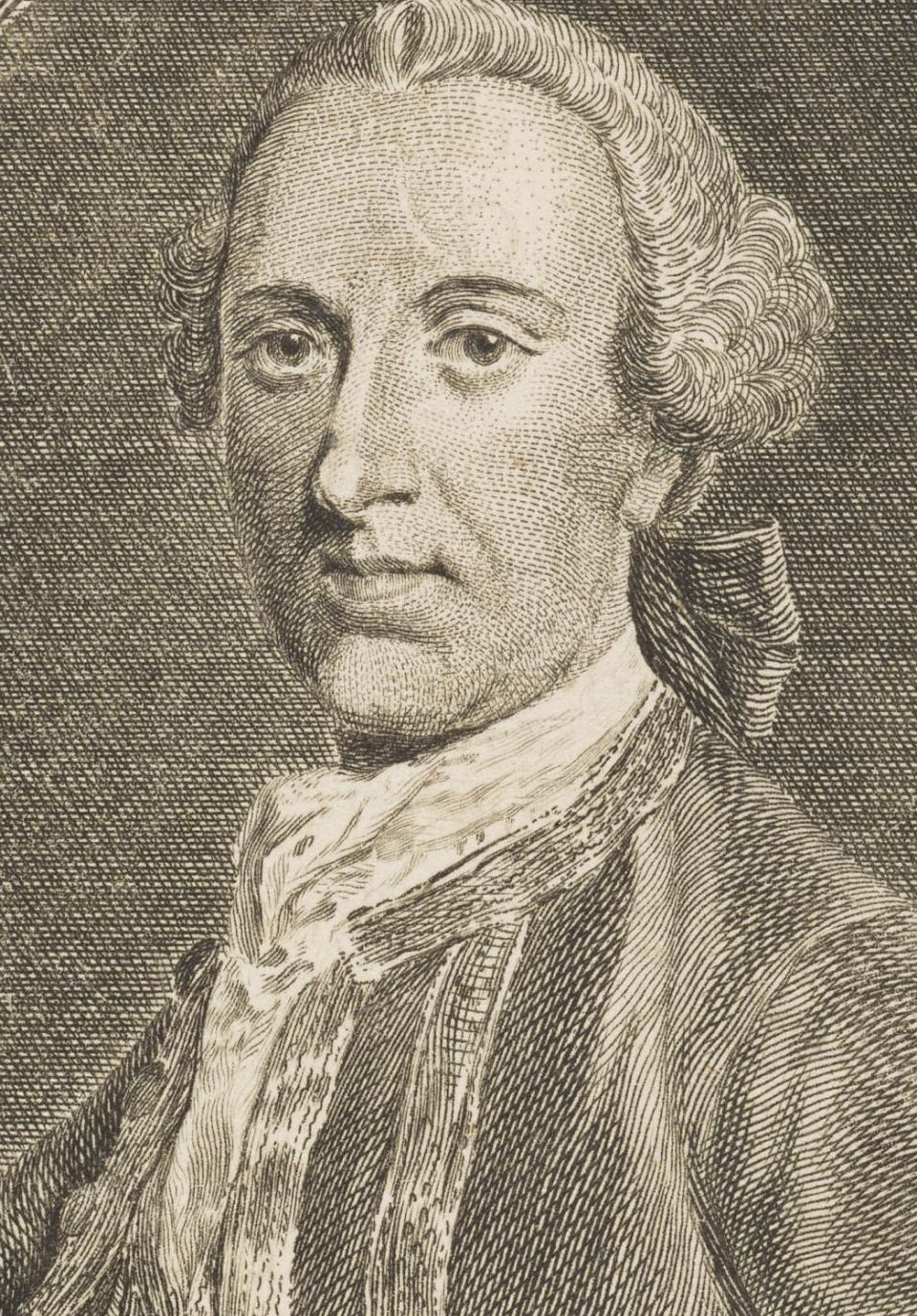
Before Lion had closed with them, Elisabeth and Du Teillay drew near each other, and Captain D’Eau went aboard Du Teillay to arrange manoeuvres.3 It was agreed that Elisabeth would suffer the first fire and then attempt to board Lion, while Du Teillay would stand by and be ready to supply Elisabeth with additional men. Both ships then prepared for action and hoisted the French flag.4
At 1700 on 9 July, 39 leagues (117 miles) west of Lizard Point, Elisabeth fired the first shot of the action. Lion returned fire and, being the more manoeuvrable vessel and having the advantage of the wind, turned and delivered another broadside which swept Elisabeth from fore to aft. Captain D’Eau and his brother, who was second in command, were struck by roundshot and killed and “there were no officers aboard, yt had resolution, or experience enough, to execut what was agreed upon”.5 Du Teillay then closed with Lion and made two attempts to rake the vessel but was forced away by Lion’s stern chase gun.
The officer who took command of Elisabeth continued to fire on Lion with guns and musketry without manoeuvring while Lion sailed freely around. Charles insisted that Du Teillay fully join the fight, however, Walsh, who knew the weakness of his ship and aware of his responsibility to preserve Charles’s life, refused and desired that Charles not press the issue any further, otherwise he would be forced to order him down to his cabin. Du Teillay remained at a safe distance for the remainder of the five-hour battle.
At around 2100, Captain Brett withdrew Lion from the close quarter battle and continued to engage Elisabeth from a distance for another hour before the badly damaged Elisabeth withdrew from the fight. Brett reported that “the French Ship sheer’d off, and in less than an Hour was out of Sight”.
Lion, which had suffered extensive damage to its rigging, masts and sails, on account of the French gunners firing high, as was their custom, was unable to pursue. Lion’s rigging had been cut to pieces, the mizenmast, mizen topmast, main yard, fore topsail yard, and main topsail mast had all been shot away, and all of Lion’s lower masts and topmasts had been shot through in many places.
Forty-five of Captain Brett’s crew had been killed in the engagement and 107 wounded, seven of whom would later die of their injuries.6 Brett himself was wounded in the arm, while his master had his right arm shot off. All of his lieutenants had been injured but had refused to leave their posts and continued to encourage their men. Lion made its way to Plymouth to refit and repair. Captain Brett and his officers believed that they had engaged a French convoy “probably bound for Newfoundland or some other of their garrisons in America” and were not aware that this was Charles Edward Stuart’s expedition sailing for Scotland.
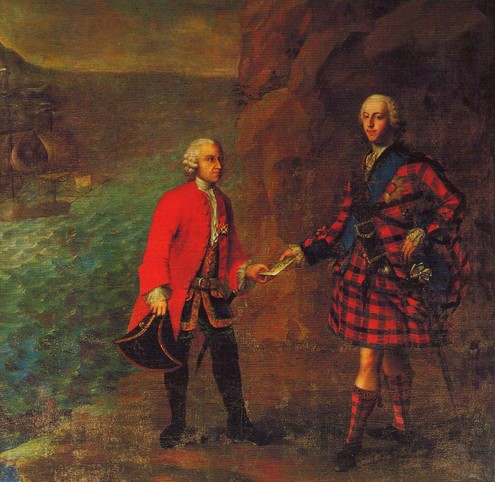
With nightfall, the crew of Du Teillay hung out lanterns and sailed to rejoin Elisabeth, which had been reduced to a splintered wreck. Elizabeth had suffered sixty-four killed and over 140 wounded. An officer on Elisabeth requested that Du Teillay send over reinforcements to help replace the losses, but Walsh refused as he had too few men to spare. Being in no condition to continue the voyage, Elisabeth made its way to Brest, taking with it the cargo of muskets and broadswords and the surviving Irish volunteers. Some of Charles’s followers tried to persuade him to turn back also, however he was resolved to continue on to Scotland.7
Du Teillay continued on its journey to the Western Highlands, sailing past the west coast of Ireland before arriving off the Isle of Barra on 22 July. The following day, Charles set foot in Scotland for the first time when he landed on the Isle of Eriskay and on the 25th, he sailed over to the mainland, landing on the shores of Loch nan Uamh. From here, he made his way to Glenfinnan, where on 19 August the Jacobite standard was raised, marking the beginning of the Jacobite Rising of 1745.
Notes:
- Some histories of the ’45 erroneously claim that there were 700 Irish soldiers on board Elisabeth. ↩︎
- John William O’Sullivan, Alistair Taylor (ed), Henrietta Taylor (ed), 1745 and After, (London 1938), p 49. ↩︎
- Ibid, p 50. ↩︎
- A report of the action of 9 July 1745 in The London Gazette, issue 8451, 20 July 1745. ↩︎
- 1745 and After, p 50. ↩︎
- The London Gazette ↩︎
- Robert Forbes, The Lyon in Mourning, volume I, p 287. ↩︎
Cite this article: Ritchie, N. S. (9 July 2025). Action between HMS Lion and Elisabeth and Du Teillay. Jacobite Wars. https://www.jacobitewars.com/articles/action-between-hms-lion-elisabeth-du-teillay/
