

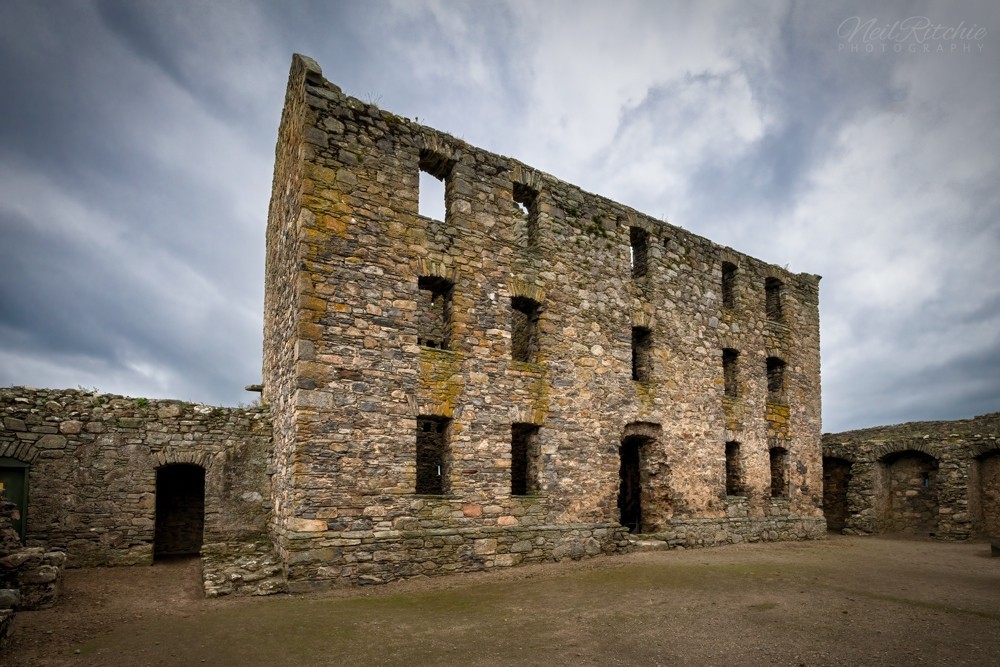
Ruthven Barracks is located on the south side of the River Spey, overlooking the small town of Kingussie in Badenoch and was one of four Highland barracks constructed by the Board of Ordnance following the Jacobite Rising of 1715. During the Jacobite Rising of 1745, Ruthven Barracks was attacked twice by the Jacobites, and it was also the site where the Jacobite army received orders to disband following their defeat at Culloden.
Ruthven Barracks
Ruthven Barracks (traditionally pronounced ‘Riven’) was built on the grounds of an earlier medieval castle. Designed by architect James Smith, construction was overseen by architect Andrew Jelfe and military engineer John Lambertus Romer, under the overall supervision of Barrackmaster-General Sir Patrick Strachan of Glenkindie.
It was Glenkindie, under instructions from the Lord Justice Clerk, who had originally devised a scheme for the construction of permanent barracks in several locations to watch over the more troublesome areas of the Highlands, support the existing garrisons, and help enforce the Disarming Act of 1715.1 In the end, four sites were picked: Inversnaid, Kilwhimen, Bernera and Ruthven.
The strategic position overlooking an important crossing on the Spey had been chosen for the new Ruthven Barracks in 1717. That year, French-born military engineer Brigadier-General Lewis Petit surveyed the site. In January 1719, the Duke of Roxburghe, Secretary of State for Scotland, informed the Board of Ordnance on the intended site for the barracks and in June, the government purchased the land and the castle ruins from the Duke of Gordon.2 Construction on the barracks began in 1720 and was fully completed in 1724.
The barracks comprised two three-story accommodation blocks that could house sixty men each, with ten men to a room and two to a bed, while the officers had private quarters. In the centre was a parade ground for drilling, and the site was surrounded by an enclosure wall with musket loops. Two projecting loopholed towers were built at diagonally opposite corners of the enclosure to allow enfilade fire along the outer walls. The barracks also featured a bakehouse, brewhouse, latrines, and a well.

In 1734, at the recommendation of General Wade, a guardhouse was added, and a stable for thirty dragoons was built, of which the attic floor was used to store hay for the horses. A postern gate was inserted in the western wall of the barracks to give access to the stable block. The dragoons were “to serve as a convoy for money or provisions for the use of the Forces as well as to retain that part of the country in obedience”.
The dragoons would patrol along General Wade’s military roads, which were constructed in the 1720s and 1730s to link the new barracks and highland forts with the lowlands and facilitate the movement of government troops into the Scottish Highlands.
The first Jacobite attack on Ruthven Barracks
At the onset of the Jacobite rising in August 1745, Lieutenant-General Sir John Cope, commander-in-chief in Scotland, led a government army of over 1,500 men into the highlands, determined to nip the rebellion in the bud before Charles Edward Stuart could raise a large army. Marching his force from Stirling on 20 August, he intended to march to Fort Augustus by way of the Corrieyairack Pass, arm the pro-government highlanders, contain the Jacobites and crush the rising in its heartland.
On arriving at Dalwhinnie on 26 August, Cope was informed that the Jacobites were lying in wait for him in the Corrieyairack Pass. Not wanting to risk forcing the Pass, Cope decided to march north to Inverness and raise the well-affected clans. On the 27th, Cope marched to Ruthven Barracks and encamped on the opposite side of the River Spey. Leaving Ruthven on the 28th, Cope left behind 64-year-old Irish sergeant Terrence Molloy, with a corporal and twelve privates of Guise’s 6th Regiment of Foot as a garrison.
Instead of following Cope towards Inverness, the Jacobites decided to move towards Blair Castle, the seat of the Duke of Atholl, and raise men from his estates. On 29 August, the Jacobites encamped at Dalwhinnie before their move south into Atholl. After arriving at Dalwhinnie, Lieutenant-Colonel Archibald Cameron, brother of Donald Cameron of Lochiel, was ordered to take a detachment of 50 Cameron clansmen and proceed to Ruthven to gather intelligence on Cope’s movements and keep watch on the road to Inverness.
Meanwhile, Colonel John William O’Sullivan, Jacobite quartermaster-general, had been sent south from Dalwhinnie to reconnoitre the road towards Atholl. He had not gone far when he received orders to gather 100 Camerons and take the road back to Ruthven, where he would meet with Lieutenant-Colonel Cameron. They were then to seize Ruthven Barracks, which was thought to be left unguarded following Cope’s departure.3
The plan to capture the barracks had been devised by Major-General John Gordon of Glenbucket, who had his reasons for wanting the barracks reduced as they sat close to his lands in Badenoch. Glenbucket insisted that the barracks would be empty and that the arms and provisions that could be found there would be of great use. Charles Edward Stuart felt that the barracks were of no importance, “and unequall to the lives of those who might fall in the attempt.”4 However, the clan chiefs backed Glenbucket’s scheme, and Charles was forced to agree to it.

Colonel O’Sullivan had misgivings about the plan, especially as the Jacobite force lacked artillery. After darkness had fallen, he went forward to investigate the barracks. O’Sullivan observed that there were “two buildings upon a sugar loaf, joyned together by a very high rampart with a parepet, which formed a Square and flanked at every corner: there were Stables detached from the barracks and surrounded by a wall breast-high, and the ramp inaccessible in a manner”.5 Upon realising that the barracks were garrisoned, he planned a two-pronged assault. He would lead one party to plant a barrel filled with flammable material against the door linking the main block to the stables, while another party, using the fire as a distraction, would scale the wall with ladders and take the garrison by surprise.
Using the stable block as cover, O’Sullivan’s party reached the door and set the barrel alight. The door was at the top of three stairs and as they tried to position the flaming barrel next to it the garrison opened fire on them, inflicting casualties. The other party, under fire from the garrison, were unable to position their ladders next to the walls and the Jacobites soon broke off the attack. Later that night, Sergeant Molloy allowed the Jacobites to approach the barracks so they could carry off their dead and wounded. Molloy had lost one soldier who had been shot through the head after sticking it above the parapet.
The following day, Sergeant Molloy wrote to Cope giving his account of the event:
Ruthven Redoubt, August 30th 1745
Honourable General, This goes to acquaint you, that Yesterday there apeared in the little Town of Ruthven above 300 Men of the Enemy, and sent Proposals to me to surrender this Redoubt, upon Condition that I should have Liberty to carry off Bag and Baggage. My answer was, that I was too old a Soldier to surrender a Garison of such strength. without bloody Noses. They threatened hanging me and my Men for Refusal. I told them I would take my Chance.
This Morning they attacked me about twelve o’Clock, by my Information with about 150 Men: They attacked Fore-Gate and Sally-Port, and attempted to set the Sally-Port on Fire, with some old Barrels and other Combustibles, which took Blaze immediately; but the Attempter lost his life by it. They drew off about half an Hour after Three.
About two Hours after they sent to me, that two of their Chiefs wanted to talk with me. I admitted and spoke to them from the Parapet. They offered Conditions: I refused. They desired Liberty to carry off their Dead men; I granted. There are two Men since dead of their Wounds in the Town and three more they took with them wounded as I am informed. They went off Westward, about eight o’clock this Morning.
They did the like March Yesterday in the Afternoon, but came back at Night fall. They took all the Provisions the poor Inhabitants had in the Town; and Mrs McPherson, the Barrack-Wife and a Merchant of the Town who spoke to me this Moment, and who Advised me to write to your Honour: And told me there were above 3000 Men all lodged in the Cornfields West of the Town last Night, and their grand Camp is at Dalwhinny: They have Cluny McPherson with them Prisoner, as I have it by the same Information.
I lost one Man shot through the Head by foolishly holding his Head too high over the Parapet, contrary to orders. I prevented the Sally-Port taking Fire by pouring Water over the Parapet. I expect another Visit this Night, I am informed, with their Pateraroes [swivel guns] but I shall give them the warmest Reception my weak, Party can afford. I shall hold out as long as possible. I conclude, Honourable General, with great Respect.
Your most obedient and humble Servant.
MOLLOY, Sergeant6
Cope forwarded the letter to the Marquis of Tweeddale, Secretary of State for Scotland, with the recommendation that Molloy should be “made an Officer for his gallant behaviour”.7 Sergeant Molloy was promoted to the rank of lieutenant, with the Commission Registers recording the promotion on 12th September 1745.
The second Jacobite attack on Ruthven Barracks
Following the aborted invasion of England, the Jacobite army of Charles Edward Stuart withdrew back to Scotland, hoping to gather more men and receive French military support. After the Jacobite victory at the battle of Falkirk and the failed siege of Stirling Castle, it was decided that the Jacobite army would withdraw northward and establish a base at Inverness to prepare for a renewed campaign southward.
On 10 February, while Charles was staying at Blair Castle, Major-General John Gordon of Glenbucket, who was leading the advance guard on the road to Inverness, moved against Ruthven Barracks, which was still held by Molloy and his small garrison who had been holding out in hostile Badenoch. This time, the Jacobites were equipped with three artillery pieces.
At 0800, Glenbucket sent a message to Molloy requesting that he surrender the barracks immediately. Molloy replied that he would not surrender the place “until he was besieg’d in form, and that he could not see yet but that he was able to make a good defence”.8 At 1300, three 4-pounder guns arrived at the village of Ruthven and were moved into position to bombard the barracks.
Three shots were fired against the garrison; however, no flag of truce was observed flying from the barracks, and Glenbucket was surprised to see that Molloy was again resolved to defend his position. Glenbucket then dispatched Colonel Grant with the following note:
There are by his R.H. Order. I send you this to desire you will surrender, without Loss of Time, to give up the Barrack, and so render yourselves Prisoners at Discretion; or these are to certify, you are to expect no Mercy. GORDON.9
Molloy replied to Glenbucket’s demands for surrender:
Sir, I don’t see but I am in a Condition to make a good Defence in my Garrison. Still I know I cannot stand a long regular Siege, especially against Cannon; yet I am resolved to the last Extremity, in every respect, to sustain the Character of a Gentleman, and to answer the Expectation and Confidence of my Royal Master, with Regard to what he has committed to my Trust. To be brief, I will not surrender until your Prince’s Approach to this place, and then upon the following Conditions only; 1st. That my Men and I be humanely treated, as I am inform’d of the Revenge and Threats denounced against us by the Clans who attacked this Garrison last August. 2nd, That we shall not be rifled or pillaged; and that your Prince grant me my Parole of Honour, and set my men at Liberty as he has done other Prisoners hitherto, considering the Difference betwix Prisoners of this Kind, and those taken in the Field of Battle – Gen. Gordon, an experienced humane Officer, can’t deny this reasonable Intreaty; and upon Preformance thereof, I will deliver the Keys of the Garrison to your Prince, and upon giving a Guarantee to fulfill the above Conditions. Further I permit Gen. Gordon to send his Horses and Grooms to my Stables this night, without Arms: All I require for my Honour and Security on this Head, is, that Col. Grant may be permitted to stay as a Hostage in my House until the Prince’s Arrival.
MOLLOY.10
Glenbucket replied that it was “too high a proposal” for Molloy to suggest handing the keys over to Charles, but was willing to compromise and suggested that if Molloy surrendered his arms and allowed 30 Jacobites to enter the barracks, then he would allow Molloy and his men to remain until Charles arrived. Glenbucket warned Molloy that this would be his final offer.
Knowing that he could not withstand an artillery bombardment, Molloy surrendered to the Jacobites at 1200 the following day. Charles arrived at Ruthven on the 12th, and later that day, Molloy and his men were released and allowed safe passage to Perth. After carrying out the provisions and bedding, the Jacobites set fire to the buildings. Charles spent three nights at Ruthven Farm before continuing on to Inverness on the 16th.
The final Jacobite gathering at Ruthven
Following the Jacobite defeat at the Battle of Culloden on 16 April 1746, the remnants of the Jacobite army assembled at the village and barracks of Ruthven with the intention of continuing the campaign. It was here that they received the final order from Charles Edward Stuart: “Let every man seek his own safety in the best way he can”.
In his Memoirs of the Rebellion in 1745 and 1746, James Johnstone recalls the gathering at Ruthven following the battle of Culloden:
I arrived, on the 18th, at Ruthven, which happened, by chance, to become the rallying point of our army, without having been previously fixed on. There I found the Duke of Athol, Lord George Murray, the Duke of Perth, Lord John Drummond, Lord Ogilvie, and many other chiefs of clans, with about four or five thousand Highlanders, all in the best possible dispositions for renewing hostilities and taking their revenge. The little town of Ruthven is about eight leagues from Inverness, by a road through the mountains, very narrow, full of tremendously high precipices, where there are several passes which a hundred men could defend against ten thousand, by merely rolling down rocks from the summit of the mountains.
Lord George immediately dispatched people to guard the passes, and at the same time sent off an aide-de-camp to inform the Prince, that a great part of his army was assembled at Ruthven; that the Highlanders were full of animation and ardour, and eager to be led against the enemy; that the Grants, and other Highland clans, who had, till then, remained neuter, were disposed to declare themselves in his favour, seeing the inevitable destruction of their country from the proximity of the victorious army of the Duke of Cumberland; that all the clans, who had received leave of absence, would assemble there in the course of a few days; and that, instead of five or six thousand men, the whole of the number present at the battle of Culloden, from the absence of those who had returned to their homes and of those who had left the army on reaching Culloden, on the morning of the 16th, to go to sleep, he might count upon eight or nine thousand men at least, a greater number than he had had at any time in his army. Every body earnestly intreated the Prince to come immediately, and put himself at the head of this force.
We passed the 19th at Ruthven, without any news from the Prince. All the Highlanders were cheerful, and full of spirits to a degree perhaps never before witnessed in an army so recently beaten, expecting, with impatience, every moment the arrival of the Prince; but, on the 20th, Mr. Macleod, Lord George’s aide-de-camp, who had been sent to him, returned with the following laconic answer; — “Let every man seek his safety in the best way he can:” – an inconsiderate answer, heart-breaking to the brave men who had sacrificed themselves for him.11
Notes:
- Calendar of Treasury Papers: 1714-1719, p 371. ↩︎
- SP 54/13/59: Robert Dundas, Solicitor General for Scotland, on purchasing land in the Highlands for the building of barracks. ↩︎
- John William O’Sullivan, Alistair Taylor (ed), Henrietta Taylor (ed), 1745 and After, (London 1938), p 65. ↩︎
- John Murray of Broughton, Robert Fitzroy Bell (ed), Memorials of John Murray of Broughton, sometime Secretary to Prince Charles Edward Stuart 1740-1747, (Edinburgh 1898), p 184. ↩︎
- 1745 and After, p 65. ↩︎
- Sergeant Molloy to Lieutenant-General Sir John Cope, Ruthven, 30 August 1745, published in: Report of the proceedings and opinion of the Board of General Officers, on their examination into the conduct, behaviour, and proceedings of Lieutenant-General Sir John Cope (1749), p 155. ↩︎
- Lieutenant-General Sir John Cope to Marquis of Tweeddale, Inverness, 31 August 1745, published in: Report of the proceedings and opinion of the Board of General Officers, p 41. ↩︎
- John Marchant, The History of the Present Rebellion, (London 1746), p 371. ↩︎
- Ibid. ↩︎
- Ibid. ↩︎
- James Johnstone, Memoirs of the Rebellion in 1745 and 1746, (London 1820), p 198. ↩︎
Cite this article: Ritchie, N. S. (10 February 2026). Ruthven Barracks during the Jacobite Rising of 1745. Jacobite Wars. https://www.jacobitewars.com/articles/ruthven-barracks-during-the-jacobite-rising-of-1745/
