

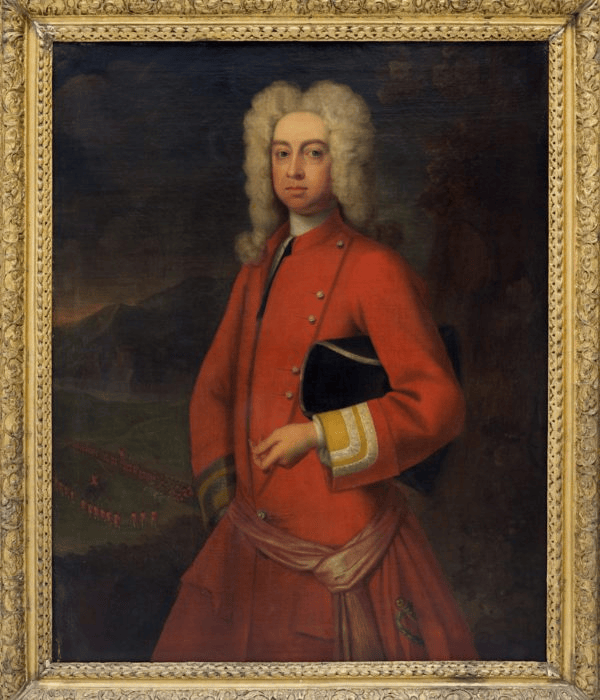
24 October 1715: The Scots Greys, commanded by Lieutenant-Colonel Charles Cathcart, attacked Jacobite forces under James Malcolm of Grange quartered in Dunfermline. Cathcart led his men into the town, half mounted and half dismounted, and took the Jacobites by surprise, taking many prisoners and scattering the rest. That evening, Cathcart and the Greys returned to the government camp at Stirling.1 A few days before, the Duke of Argyll, commander-in-chief of the government forces in Scotland, had received intelligence that a Jacobite contingent comprising roughly 80 cavalry and 300 Highlanders was en route to Fife, intending to gather supplies and levy the cess tax to bolster the main Jacobite army stationed in Perth. Argyll ordered Lieutenant-Colonel Charles Cathcart to intercept them.
24 October 1745: The Duke of Newcastle sent an order to the Duke of Montagu, Master-General of the Ordnance, for 500 muskets “with ammunition in proportion” and 500 broadswords to be sent from Liverpool to Inveraray to the order of Archibald Campbell of Stonefield, sheriff-depute, and Lieutenant-Colonel John Campbell. A royal warrant authorising the raising of the Argyllshire militia had been signed on 22 October. Newcastle also signed a warrant for the sheriff to arrest James Campbell of Auchinbreck on suspicion of high treason.2
Notes:
- Peter Rae, The History of the Late Rebellion: Rais’d Against His Majesty King George, (1718), p 294. ↩︎
- James Fergusson, Argyll and the Forty-Five, (London 1951), p 36 ↩︎
Article first published on 24 October 2025
